

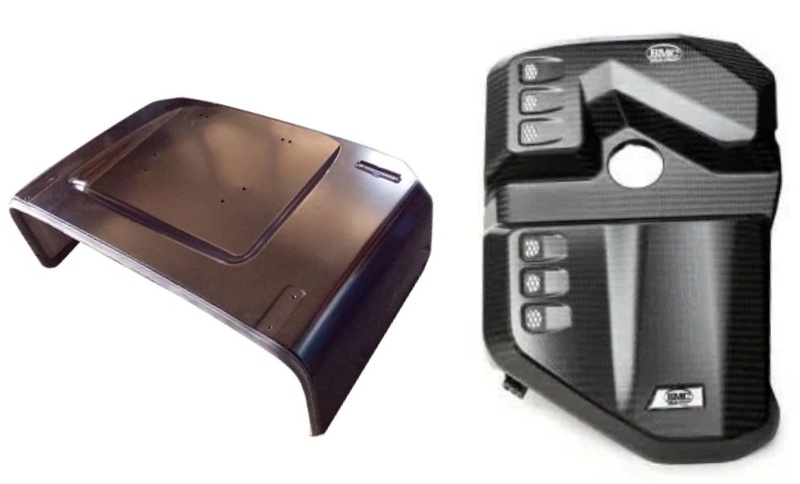
BMC/SMC Engine Hood
Material Properties
BMC material: A bulk prepreg mainly composed of chopped glass fibers, unsaturated resin, fillers, and various additives after thorough mixing. It has excellent electrical properties, mechanical properties, heat resistance, and chemical corrosion resistance, and can form products with complex structures in one go.
SMC material: It is an intermediate material for molding glass fiber reinforced plastic products by dry method. It is made by pre-mixing unsaturated polyester resin, low-shrinkage/low-profile additives, initiators, internal mold release agents, mineral fillers, etc. into a paste, adding thickeners and other substances, mixing evenly, and then fully impregnating chopped glass fibers to form a sheet-like "sandwich" structure. It has high strength, rigidity, toughness, heat resistance, corrosion resistance and other properties.
Performance Advantage
sLightweight: BMC and SMC engine hoods have a small specific gravity. Compared with traditional steel plate hoods, their weight can be significantly reduced. For example, the weight of SMC forklift engine hoods can be reduced by more than 70%, which helps reduce the overall weight of the vehicle and improve fuel economy.
High strength: The reinforcing effect of glass fibers gives them high strength and rigidity, which can withstand various stresses in the engine compartment and meet the strength requirements during vehicle operation.
Corrosion resistance: It has good acid and alkali resistance and moisture resistance, can effectively resist corrosive gases and liquids in the engine compartment, and extend the service life of the engine hood. It is especially suitable for scenarios such as electric forklifts, and can maintain a good insulation state with the battery pack under the hood.
Good surface quality: Through molding, high surface flatness can be obtained, reaching Class A surface, without a lot of subsequent polishing and modification, and the appearance quality is high.
Advantages of molding process: Complex products can be integrally formed, and inserts, holes, platforms, ribs, grooves, etc. can be formed at the same time, with high production efficiency and high raw material utilization rate.
Application ScenariosAutomotive field:
BMC engine hoods are often used in some small automotive parts with high requirements for structural complexity, such as components under the engine hood of high-end sports cars.
SMC engine hoods are widely used in the main body of engine hoods for cars, buses, etc. For example, the engine hood of models such as BYD Seal can be formed using SMC molding process.Engineering machinery field: Engine hoods of engineering machinery such as forklifts, loaders, and excavators often use SMC materials. Their characteristics of stable thermal performance and good sound absorption performance can meet the usage requirements of engineering machinery.
Manufacturing ProcessBMC molding process: Put the BMC bulk prepreg into the mold cavity, and cure it under a certain temperature (usually 140-160℃) and pressure (10-30MPa) for a certain molding time (2-5 minutes).SMC molding process: First, cut the SMC sheet blank as required and put it into the mold, then perform molding under similar temperature and pressure conditions, and obtain the engine hood product after curing.
Development Trend With the continuous improvement of automotive lightweight and environmental protection requirements, BMC and SMC engine hoods are expected to be more widely used. In the future, their development will focus on further improving performance, such as enhancing strength and heat resistance by optimizing material formulas and molding processes; at the same time, continuous exploration will be made in recycling to reduce environmental impact.
CONTACT US
